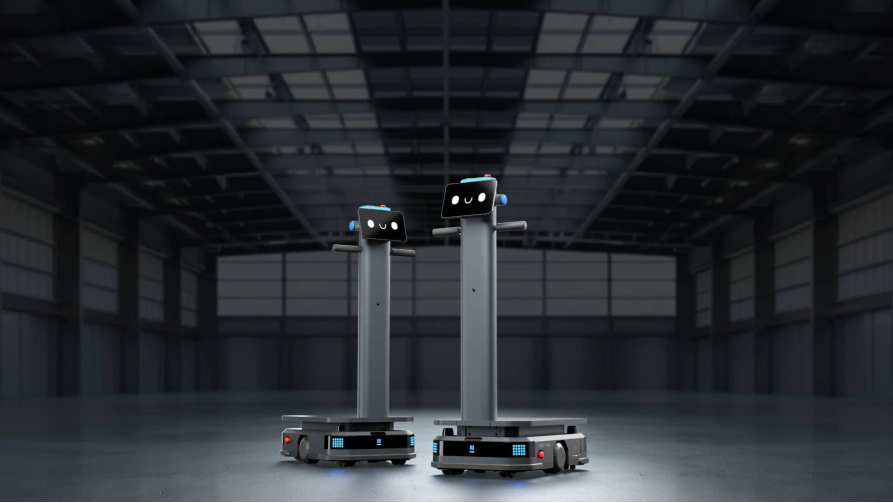
Why PCB fabs are now treating low-payload industrial robots as a flexibility play, not a heavy-logistics project, with a deployment example from a Taiwan-based top-tier HDI manufacturer.
May 26, 2026 | About 12 minutes read
PCB manufacturing is a deceptively quiet candidate for industrial automation. The press headlines go to electric-vehicle gigafactories and 300 mm semiconductor fabs, but the boards inside those products are still being built in a network of high-density PCB fabs that look, on the floor, more like a busy electronics workshop than a fully automated line. Layouts shift every twelve to eighteen months. Aisles fill up with bins, dollies, racks, work-in-progress carts, and operators carrying inspection trays. Anything you add to that environment has to fit through narrow gaps without disrupting the line.
That is why a recent deployment at a Taiwan-based top-tier HDI PCB manufacturer is worth reading carefully. The site is one of the top six PCB producers globally by revenue and the global leader in HDI by share, supplying smartphone, automotive, and high-end consumer electronics customers. It added only two industrial robots to start. Both went into one specific workflow: moving finished OSP sample boards to a visual inspection area, and returning empty racks back to the line.
Two robots, one loop, one workflow. That is a very different procurement story from the heavy-logistics AMR projects buyers usually see written up, and the more useful one for most PCB operations teams.
Why PCB fabs are quietly reopening the intralogistics conversation
Two trends are pushing PCB intralogistics back onto procurement agendas. First, the IPC’s 2024 global PCB outlook described a market that is shifting toward higher-mix, higher-complexity boards: HDI, IC substrate, and automotive multilayer. Higher mix means more frequent product changeovers, smaller batch sizes, and more sample movement between process steps and inspection. Second, the International Federation of Robotics’ 2024 World Robotics report confirmed that mobile robot adoption in electronics manufacturing kept growing through the post-pandemic period, even while overall industrial robot installations in some markets cooled.
Buyers reading those signals often jump straight to the most ambitious option: a turnkey AGV/AMR project that automates inter-process board movement end to end. In practice, that is the project most likely to stall. PCB fabs change layout every one to two years, sometimes more often when a new product family is introduced. A multi-million-dollar fleet planned around last year’s floor plan does not survive contact with the next reorganization.
The deployment pattern at the anonymized HDI manufacturer is instructive precisely because it does the opposite. It treats the robot fleet as a flexible peripheral, not a fixed asset. The first task is small, the redeploy cost is low, and the workflow chosen is one that recurs across almost every process step in a PCB fab.
The deployment pattern: two industrial robots in an OSP sample-transfer loop
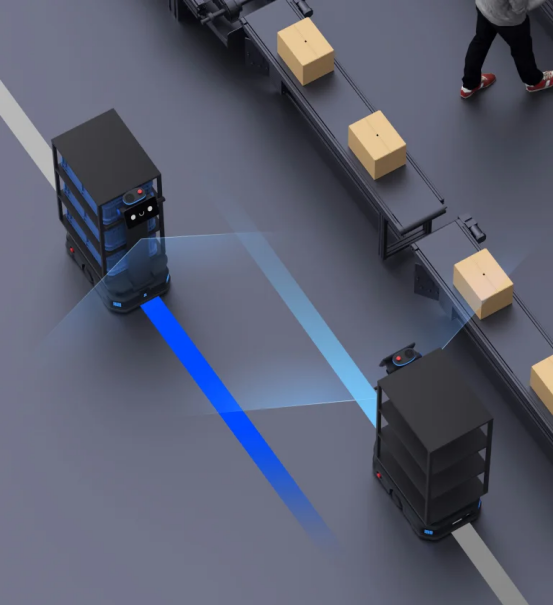
Figure 1. Industrial AMR moving sample trays alongside a production line, the workflow pattern used in the OSP sample-transfer loop.
The customer is an anonymized Taiwan-based top-tier HDI PCB manufacturer, top six globally in PCB revenue and the global leader in HDI revenue share. Two PUDU T300 industrial autonomous mobile robots were deployed in the OSP (organic solderability preservative) process area. The task is straightforward to describe: lift sample trays from the OSP workshop, deliver them to the visual inspection / sample check area, then return the empty racks back to the source. The robot performs an in-place jacking lift and an automated drop-off, with the operator only handling tray staging.
On paper this looks modest. Operationally, it is a useful test of three things at once. Can the robot navigate aisles that change shape every quarter? Can it slip through gaps blocked by dollies, work-in-progress carts, and ad hoc staging without intervention? Does the round trip save enough operator time that the loop pays back on its own, even before a broader rollout is approved?
The first answer the deployment gave is the most important: the workflow runs without redesigning the OSP floor. Trays go where operators already place them. Inspection receives them where it already inspects them. Empty racks return where they already pile up. The robot replaces the walk, not the workflow.
Three operational features of PCB fabs that shape robot selection
The Pudu Robotics field engineering team has now installed more than one hundred T-series industrial robots into PCB production environments across multiple countries. Three patterns repeat in nearly every site, and each one changes the calculus for what kind of AMR fits.
1. Layout changes every one to two years
PCB fabs reconfigure constantly. New product introductions move the inspection floor. Yield campaigns add or relocate test stations. A new automotive customer triggers a clean-room sub-area. In these conditions, infrastructure-heavy automation, fixed conveyors, AGV magnetic tape, hard-coded routes, becomes a liability. The same robot has to be redeployed three or four times during its useful life. Mapping, route planning, and integration tools matter more than peak speed.
2. Floor space is occupied, not empty
PCB workshops use space hard. Carts, bins, work-in-progress racks, sample tables, hand trucks, and equipment trolleys all spill into the main aisles. The clearance an AMR actually has to drive through is often well below specification on paper. Buyers usually overestimate how much aisle their robot will see, and an AMR that requires 1.2 meters of clear path simply does not run in a real PCB fab. Compact footprint, omnidirectional perception, low-obstacle detection, and tight-corner navigation are not nice-to-haves, they are entry criteria.
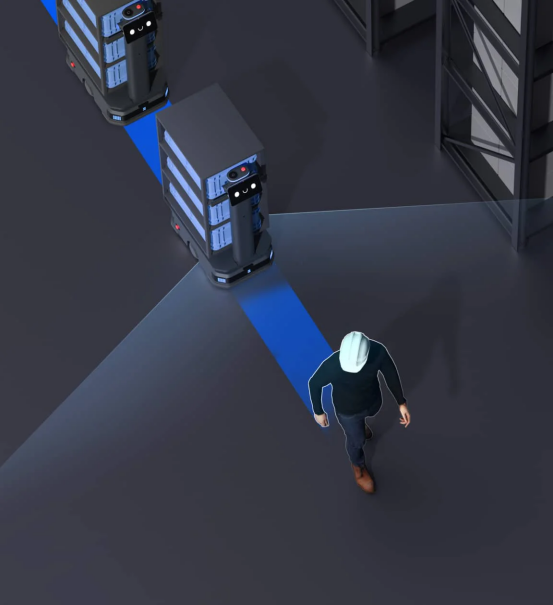
Figure 2. Compact-footprint industrial AMRs sharing tight factory aisles with operators and equipment.
3. The real automation gap is not main-line conveyance
Buyers tend to imagine PCB automation as inter-process board transport, the heavy material flow between major process steps. In practice, most of the manual minutes per shift are absorbed by smaller, repeatable jobs around each step: sample-to-inspection delivery, empty-bin and rack return, line-side material replenishment, sub-area buffer pickups, and ad hoc fixture / accessory delivery. Each process step typically has one to three of these tasks. They are standardized, similar in size and weight, and easy for a salesperson to explain to a customer.
That third pattern is the practical lesson from the anonymized HDI fab. Two robots, in one of those small standardized loops, is a more honest first project than a fleet plan against a moving floor plan.
Workflows in a PCB fab that fit a low-payload industrial AMR
Once you accept that the entry point is a small loop rather than full inter-process automation, the next question is which loop. The matrix below summarizes the workflows where a 300 kg-class low-profile industrial robot like PUDU T300 fits cleanly, based on the workflow taxonomy used by the field engineering team across the T-series PCB deployments.
| Workflow | Typical load | Fit for a 300 kg-class low-profile AMR | Why |
| Sample-to-inspection transfer (OSP, AOI, X-ray, electrical test) | Trays / racks, 20-150 kg | Strong | Standardized, recurring, low integration risk; one of the highest-frequency tasks per shift. |
| Empty rack / empty box / fixture return | Empty racks, 5-40 kg | Strong | Combines naturally with sample transfer to form a closed loop; pays back on its own. |
| Line-side replenishment of small materials and accessories | Small parts boxes, 5-80 kg | Strong | Standardized container sizes; recurring across nearly every process step. |
| Buffer / WIP storage retrieval at sub-area level | Trays / racks, 50-200 kg | Good | Requires light scheduling integration with WIP system, but workflow itself is simple. |
| Inter-process WIP conveyance between major process steps | Full PCB batches, 100-500+ kg | Project-dependent | Higher integration cost, more sensitive to layout change, usually better tackled after the entry loop has paid back. |
| Heavy chemical drum / large equipment movement | 300+ kg, often hazardous | Out of scope here | Use purpose-built equipment with appropriate safety certifications. |
Table 1. Workflow-fit matrix for a low-payload industrial AMR in a PCB fab.
The first three rows are the natural entry workflows. They share four properties that make them safe first projects: predictable load sizes, standardized handoff points, repeatable timing, and a sales-and-operations narrative that the line manager can explain in a sentence. The HDI fab deployment lands directly in those rows.
What the T300 contributes operationally
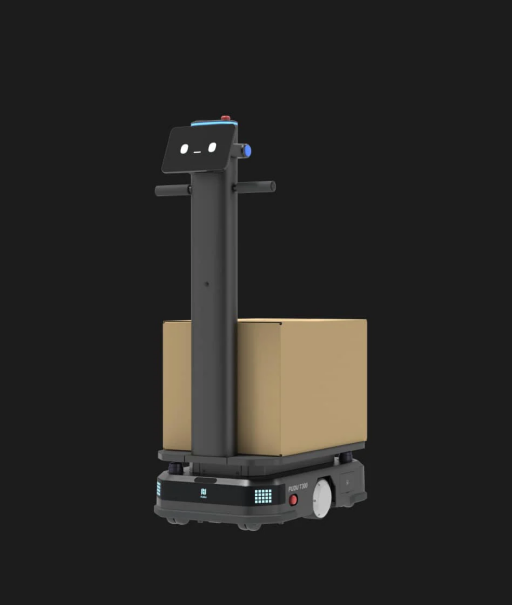
Figure 3. Industrial AMR using a jacking lift to transfer a container, the same mechanism used in the OSP sample-transfer loop.
The PUDU T300 is built for exactly the constraints described in the previous section: a 300 kg payload class with a low profile, flexible VSLAM positioning that does not require magnetic tape or reflectors, omnidirectional perception including low and suspended obstacle detection, around 60 cm path clearance, an ISO 3691-4 conformant safety design, and 24/7 operation. None of those are individually unique. What matters is that the combination matches the floor that a PCB fab actually has, not the floor that an idealized fleet plan assumes.
In the OSP loop, the operationally interesting capability is the in-place jacking lift. The robot does not need a dedicated docking station, conveyor handoff, or chute. It positions under the staged rack, lifts, drives, lowers at the inspection area, and reverses for the empty-rack return. The line keeps using the same trays and the same staging spots. That is what keeps the integration cost low enough for a two-robot first project to make sense.
Where Pudu Robotics fits in the global industrial AMR landscape
Procurement teams reasonably want to know who they are buying from before they sign a multi-site rollout plan. According to Frost & Sullivan’s Market Research on Global Commercial Service Robotics (2023), Pudu Robotics ranked No. 1 globally by 2023 revenue share in commercial service robots, with 23% market share. KEENON Robotics held 11%, Gausium 8%. For an industrial buyer, that signal matters less as a brag and more as a deployment-base signal: the vendor has the install base to harden product, the service depth to support multi-site operations, and the engineering capacity to keep iterating on workflows that small vendors cannot sustain.
Inside that portfolio, the T-series industrial robots are the entry point for manufacturing environments rather than the hospitality or retail product lines, which keeps the conversation operationally focused: this is the side of the company that talks payload, clearance, ISO 3691-4, and fleet management, not table service.
What PCB procurement teams should evaluate next
If the deployment pattern described in this article fits your fab, the most useful next step is not an RFP for an enterprise AMR platform. It is a workflow audit aimed at finding two or three short loops that are recurring, standardized in container size and weight, and currently absorbing manual minutes that would compound across a year of operation. Sample-to-inspection transfer, empty-rack return, and line-side accessory delivery are the canonical first three.
From there, four questions decide whether a low-profile industrial AMR like PUDU T300 belongs in the loop:
– How much narrowest aisle clearance is actually available across the route during a typical shift, not on a CAD drawing?
– How often does the route or layout change, and how expensive is a re-mapping or re-deployment?
– What is the safety certification expected by the site, the customer audit, and the local regulator (for example, ISO 3691-4 conformance)?
– What is the service footprint of the vendor in your country and across the sites you intend to expand to?
The answers usually resolve into a small first project, not an enterprise rollout. That is the right shape for a PCB fab that will reconfigure again in eighteen months.
FAQ
What payload class of industrial AMR is right for a PCB fab?
For the entry workflows described above, sample transfer, empty rack return, and line-side accessory delivery, a 300 kg-class low-profile AMR is the most common fit. Heavy inter-process board flow may need a higher-payload AMR or AGV, but that is a later project.
How disruptive is deploying an AMR into a live PCB fab?
Less than buyers expect when the first project is one short loop. The HDI fab deployment did not require redesigning the OSP floor: trays are picked up where operators already stage them, and empty racks return to where they already accumulate. The disruption rises when scope expands to inter-process board conveyance, which is why most teams should not start there.
Do we need a fixed conveyor or magnetic-tape AGV instead?
Usually not, in a fab that reconfigures every one to two years. Infrastructure-bound automation tends to be the first thing that has to be ripped out when the floor changes. Flexible VSLAM-based AMRs keep their value across reconfigurations, which is one of the practical reasons PCB sites have moved toward them.
How should we evaluate vendors beyond the spec sheet?
Three checks tend to separate viable vendors from optimistic ones: an on-site obstacle and clearance walkthrough with the actual worst-case aisle, a redeployment estimate for a hypothetical layout change one year out, and a same-region service plan covering response time, spare parts, and software updates.
References & Further Reading
1. IPC. Global PCB industry outlook and market reports. https://www.ipc.org/
2. International Federation of Robotics. World Robotics 2024. https://ifr.org/
3. Frost & Sullivan. Market Research on Global Commercial Service Robotics (2023). https://www.frostchina.com/en/content/insight/detail/66b96cfadce2a58aa58ac492
4. Pudu Robotics. PUDU T300 industrial autonomous mobile robot. https://www.pudurobotics.com/en/products/pudut300
5. Pudu Robotics. Smart manufacturing case study, multi-robot collaboration. https://www.pudurobotics.com/en/case-studies/pudu-tri-robot-battery

