Modern industrial assembly facilities face extraordinary production pressures when attempting to meet aggressive vehicle delivery schedules and electronic component quotas. Manual joining techniques frequently fail to deliver the requisite repeatability, introducing high scrap rates and costly rework loops.
Engineering managers grapple with severe labor shortages and inconsistent weld quality stemming from human fatigue during multi-shift operations. Transitioning to advanced automated manufacturing assets has transformed from an operational luxury into an absolute survival requirement.
Production lines handling lithium-ion battery modules and complex automotive body structures cannot tolerate the margin of error inherent in manual spot welding. Dissimilar metal stacks, tight geometric constraints, and rapid thermal dissipation require instantaneous adjustments that human operators simply cannot execute.
Addressing these advanced joining challenges demands intelligent machinery capable of regulating electrical current and physical electrode force simultaneously. Plant operators must understand why mechanistic production integration dictates long-term market competitiveness.
Overcoming Human Fatigue and Manual Assembly Bottlenecks
Manual spot-welding operations expose assembly plants to inconsistent electrode force application and fluctuating dwell times driven by physical operator fatigue. Human workers cannot sustain microsecond-level timing control during demanding multi-shift production campaigns, leading to hidden micro-voids and structural weaknesses.
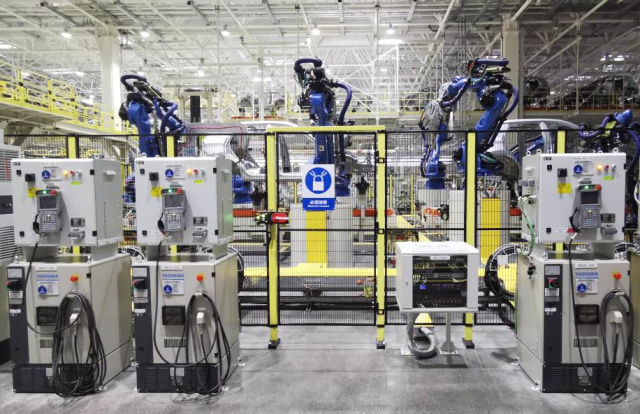
Factory floors demanding high output rates require automated welding solutions to eliminate manual variances across delicate structural joints. Mechanized systems maintain uniform force and displacement profiles across every single assembly cycle without performance degradation.
Operator turnover and variable skill levels further destabilize manual production workflows, resulting in unpredictable weld nugget growth and frequent line stoppages. Automated cells remove human variability by executing pre-programmed welding schedules with absolute physical consistency and millimeter precision.
Industrial integrators configure robotic arms to replicate optimal joining trajectories while maintaining constant pressure across variable sheet metal thicknesses. This mechanical consistency protects assembly lines against unexpected quality escapes and reduces operator training overhead.
Meeting Strict Metallurgical Tolerances in High-Mix Production
Modern vehicle bodies and battery enclosures incorporate advanced high-strength steels and lightweight aluminum alloys requiring precise thermal management during joining. Standard manual equipment lacks the dynamic feedback control required to prevent severe metal expulsion or cold shunts on sensitive assemblies.
Specialized resistance welding applications demand synchronized electrical power regulation and multi-axis kinematic control to protect delicate internal component architectures. Automated systems adjust firing profiles dynamically to compensate for microscopic surface oxidation or minor thickness deviations.
Multi-material battery busbar connections introduce severe electrical resistance fluctuations that defy open-loop power supplies and basic manual control equipment. Automated joining platforms process secondary feedback signals instantly, modulating pulse widths to optimize thermal energy delivery within milliseconds.
This precise heat containment prevents thermal degradation in surrounding lithium-ion cell enclosures while ensuring deep metallurgical bonding. Manufacturers achieve superior structural integrity that satisfies stringent crash-testing certifications and global safety compliance mandates.
Integrating High-Speed Joining Cells Into Enterprise Networks
Smart factories require seamless communication between shop-floor hardware and centralized manufacturing execution databases to achieve comprehensive digital traceability. Isolated manual cells prevent quality managers from tracking historical waveform data or detecting gradual electrode wear patterns before catastrophic failures occur.
Integrating modern automated welding solutions bridges this data gap by streaming real-time current, voltage, and displacement logs directly to plant servers. Sunke provides sophisticated controller interfaces that empower multi-axis robotic cells to communicate fluidly with overarching enterprise quality networks.
Networked automated cells enable proactive maintenance scheduling by identifying subtle thermal anomalies and resistance drift before structural weld integrity is compromised. Enterprise software systems aggregate performance metrics from multiple robotic stations, allowing metallurgists to standardize optimal parameters across global facilities.
Across complex industrial joining processes, mastering resistance welding applications enables facilities to maintain absolute quality control. Real-time error-proofing protocols instantly halt production whenever an individual weld cycle deviates from certified mathematical envelope bands.
Evaluating Capital Investment and Long-Term Operational Scalability
Capital expenditure approvals for factory automation demand clear justification regarding long-term return on investment, equipment durability, and maintenance overhead. Plant directors must weigh upfront robotic integration costs against continuous savings derived from reduced scrap rates and extended electrode lifespans.
Complex retooling initiatives require robust hardware that adapts easily to frequent model changeovers without requiring massive mechanical redesigns. They engineer flexible controller platforms and high-performance transformers that streamline system reconfiguration across changing product life cycles.
Scalable automation architecture allows growing manufacturing enterprises to expand production lines rapidly without overhauling existing core infrastructure or control networks. Modular joining hardware accommodates diverse robotic payload capacities and specialized weld gun configurations with minimal engineering downtime.
Modern power regulation units support seamless multi-axis expansion while maintaining rigorous electrical safety standards. Strategic equipment investment secures long-term manufacturing agility and operational resilience in volatile global markets.
Conclusion
Achieving sustained profitability in modern manufacturing sectors depends entirely on replacing inconsistent manual methods with disciplined, high-speed robotic integration strategies.
Facilities that embrace advanced joining technology successfully eliminate chronic quality bottlenecks while satisfying stringent international automotive safety standards. Sunke supports global industrial leaders by delivering dependable hardware architectures designed to withstand the rigors of heavy multi-shift production. Ultimately, transitioning to fully mechanized assembly lines secures long-term operational resilience and unyielding product quality.

