For printing businesses evaluating new equipment, the UV DTF printer price is only one part of a much larger investment equation. A lower purchase price may appear attractive at the beginning, while differences in productivity, maintenance needs, consumable use, technical support, and usable production capacity can significantly affect long-term operating economics.
This makes return on investment (ROI) and total cost of ownership (TCO) essential evaluation tools. Rather than focusing only on what a machine costs to purchase, business buyers need to consider what it costs to operate over time and how effectively it supports revenue-generating production.
Why the UV DTF Printer Price Does Not Tell the Whole Story
The upfront UV DTF printer price is the most visible cost, but it does not represent the complete financial commitment. Buyers should also account for installation, operator training, inks, films, maintenance, replacement parts, electricity, labor, and potential production downtime.
Production requirements also influence the economics of a purchase. A machine selected primarily because of its low initial price may become less economical if its output cannot keep pace with order volume or if frequent interruptions reduce available production time.
For this reason, a more useful comparison examines cost in relation to productive capacity. The key question is not simply, “How much does this printer cost?” but “How much reliable output can this investment generate during its working life?”
Calculating ROI from Revenue and Production Capacity
ROI measures the return generated by an investment relative to the investment cost. For a UV DTF operation, the calculation begins with realistic production and sales assumptions rather than a printer’s theoretical maximum output alone.
Buyers can estimate potential revenue by considering usable production hours, average order volume, material costs, labor costs, selling prices, and expected machine utilization. From there, they can assess how much contribution each productive hour may generate.
Capacity matters because higher output can increase potential production capacity when printing speed is the limiting factor in the workflow. However, speed should always be evaluated alongside print quality and operational stability. Output that cannot meet customer requirements may create rework and reduce the financial value of higher production speeds.
How Printhead Configuration Affects UV DTF Printer Price
Printhead configuration is one factor that can influence both equipment cost and production potential. Machines with more printheads may carry a higher initial UV DTF printer price, but additional printheads can also support higher throughput or production-oriented workflows.
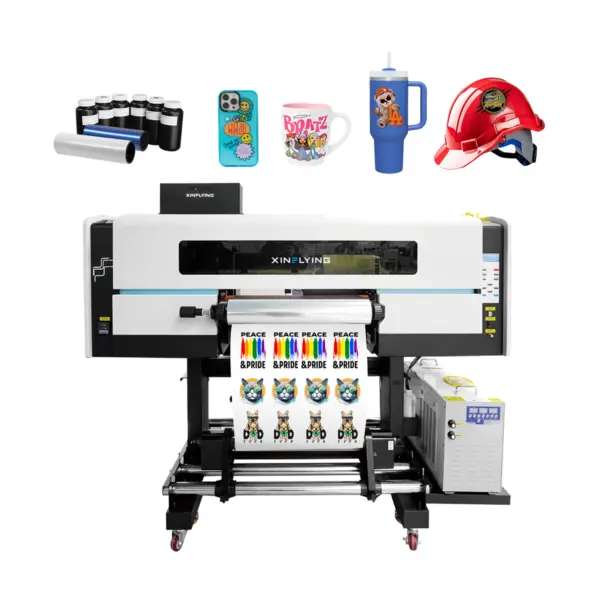
The XF-600 from Xinflying illustrates this relationship. The 24-inch UV DTF printer is equipped with three Epson i3200-U1 printheads. It delivers 6.28 m²/h at 6-pass printing and 4.85 m²/h at 8-pass printing.
Its 24-inch printing width also supports wider transfers and multi-design layouts. For commercial users, this can help increase the amount of printable work arranged in a production run, depending on artwork size, nesting efficiency, and workflow requirements.
When evaluating a UV DTF printer manufacturer, buyers should therefore compare printhead configuration and verified productivity figures with their actual order profile. Paying more for capacity that remains unused may not improve ROI, while insufficient capacity can restrict future growth.
Total Cost of Ownership Includes More Than Consumables
Consumables are recurring operating expenses and should be included in every TCO calculation. UV inks, transfer films, adhesive-related materials, cleaning supplies, and other workflow consumables all contribute to the cost of producing finished transfers.
Waste is equally important. Material loss during setup, testing, maintenance, or reprints can raise the effective cost per completed order. Businesses should therefore evaluate not only consumable purchase prices but also how consistently materials are converted into sellable output.
Labor should be included as well. A workflow requiring repeated manual intervention can increase the real cost of production even when the equipment itself is competitively priced. Ease of operation and process stability can consequently affect long-term profitability.
Downtime Can Be One of the Most Expensive Hidden Costs
Unplanned downtime is often overlooked when comparing equipment quotations. A printer that is unavailable cannot produce revenue, and delays can also affect order schedules, delivery commitments, and customer relationships.
The cost of downtime extends beyond repair expenses. Operators may remain idle, urgent jobs may need to be outsourced, and production teams may need to work overtime after the machine returns to service.
This is why after-sales resources should form part of a TCO assessment. Installation guidance, operator training, remote troubleshooting, access to spare parts, and technical assistance can all influence how quickly production issues are resolved.
Xinflying positions its business around integrated printing solutions and provides technical assistance, online training, and after-sales support for its equipment. These services can be relevant to commercial buyers because the purchase decision involves an operating system rather than a machine alone.
Evaluating the XF-600 for Production-Oriented Applications
The XF-600 is designed around a combination of format width and multi-printhead output. Its three Epson i3200-U1 printheads, 24-inch printing width, and stated speeds of 6.28 m²/h at 6 pass and 4.85 m²/h at 8 pass provide measurable specifications that buyers can use when estimating capacity.
The machine is intended for UV DTF transfers on compatible surfaces such as glass, metal, and plastic. This application flexibility may help businesses serve multiple product categories without investing in separate decoration systems for every substrate type.
For ROI planning, buyers can translate the printer’s specified output into their own operating assumptions. Actual results will depend on artwork coverage, pass settings, maintenance time, job changes, material handling, operator practices, and other production variables.
What to Ask a UV DTF Printer Manufacturer Before Buying
A detailed quotation should be the beginning of due diligence rather than the final comparison point. Business buyers should request verified technical specifications, recommended production workflows, consumable requirements, warranty terms, maintenance procedures, and information about available technical support.
It is also useful to ask how the proposed configuration matches expected production volume. Print width, printhead quantity, stated output, and workflow design should be evaluated against projected daily and monthly demand.
A capable UV DTF printer manufacturer should be able to provide clear product documentation and explain the practical operating requirements behind the quoted UV DTF printer price. Transparent information gives buyers a stronger basis for estimating ownership costs and expected payback periods.
Looking Beyond the Purchase Price
Modern UV DTF equipment should be evaluated as a long-term production investment rather than a standalone purchase. The most meaningful financial analysis combines the initial UV DTF printer price with consumables, labor, maintenance, downtime risk, support resources, and realistic productive capacity.
For businesses considering a production-oriented model such as Xinflying’s XF-600, the relevant figures include its 24-inch printing width, three Epson i3200-U1 printheads, and specified output of 6.28 m²/h at 6 pass or 4.85 m²/h at 8 pass. These specifications provide a starting point for a business-specific ROI calculation.
Ultimately, a well-informed purchase decision comes from connecting technical specifications with actual operating conditions. When buyers assess the complete cost of ownership and expected revenue potential, they can evaluate UV DTF equipment based on long-term business economics rather than the initial quotation alone.

