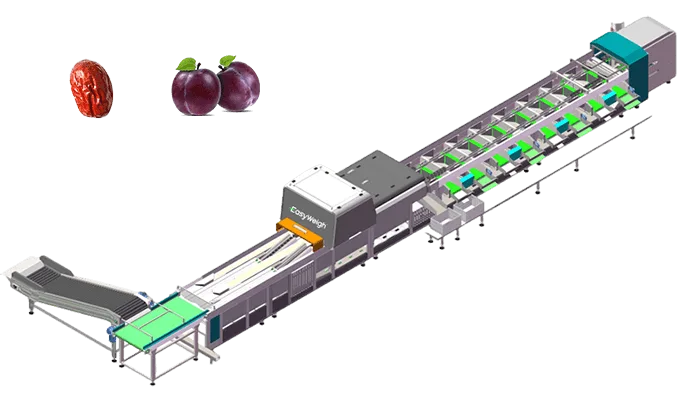
Industry‑wide reports on traditional manual inspection show an alarming 15%‑to‑20% defect escape rate during peak operating hours in industrial food‑processing facilities.Human workers suffer from rapid visual fatigue, causing inconsistent grading standards and frequent contamination leaks into commercial packaging.
Overcoming this quality deficit requires shifting from subjective human observation to quantifiable automated precision. Measuring quality improvement depends entirely on contrasting historical manual error rates against modern high-speed machine performance metrics.
Establishing the Baseline: Human Error and Manual Inspection Limits
Manual sorting benches rely heavily on human operators scanning hundreds of moving items per minute under harsh factory lighting. Experimental studies across food processing plants show worker accuracy drops by nearly thirty percent after ninety minutes of continuous labor. This human limitation creates an unstable baseline of operational unreliability where foreign materials routinely slip past inspection.
Production managers struggle to maintain uniform product purity when grading standards fluctuate with shift changes and personnel turnover rates. Establishing a true quality improvement metric requires acknowledging these baseline human failures before evaluating automated hardware solutions. Legacy inspection methods simply cannot cope with the velocity and mechanical complexity of modern manufacturing volume demands.
Relying on human visual estimation leaves facilities vulnerable to severe customer complaints and expensive product recalls due to undetected contamination. Quantifying the failure rate of manual sorting proves that human labor is fundamentally incapable of sustaining zero-defect production targets. Upgrading plant infrastructure requires a complete departure from manual inspection baselines toward verified automation systems.
Escalating Precision Through Multi-Spectrum Analysis
Adopting an optical sorting machine immediately alters facility accuracy baselines by replacing subjective estimation with sub-millimeter digital scanning. High-resolution camera arrays capture tens of thousands of pixels per square inch at speeds exceeding three meters per second. This technological shift reduces surface defect escape rates from double-digit human error percentages down to near-zero tolerance levels.
Multi-angle LED lighting illuminates items uniformly, eliminating shadows that obscure minor color shifts and shape deformations from view. Advanced digital filters isolate specific spectral bands to detect subtle bruising and organic contamination instantly without slowing down transport belts. Processing speeds remain completely unaffected while inspection consistency stays locked at one hundred percent across every shift.
Digital vision analytics process surface attributes with mathematical repeatability that manual crews can never replicate under production pressure. Every scanned item undergoes instantaneous pixel comparison against strict pre-programmed quality thresholds established by plant quality directors. Eliminating subjective human judgment guarantees that outgoing product appearance remains exceptionally uniform across massive commercial batches.
Closing the Gap With Dynamic Weight Integration
Surface purity scanning alone fails to identify internal structural cavities or density discrepancies hidden beneath opaque outer layers. Production facilities must pair optical clarity with precise mass verification to achieve total quality assurance across sensitive product categories.
Implementing Weight Sorting modules directly alongside vision systems bridges this critical operational evaluation gap seamlessly during active processing. Dual-parameter verification ensures that items meeting visual criteria but failing mass standards face immediate classification correction on the line.
Easyweigh engineers unified control architectures that process both optical pixels and weight signals through a single central processor. Operators manage multi-tiered grading parameters via intuitive touchscreens, eliminating manual data entry mistakes and streamlining daily recipe changes.
Synchronizing optical data with mass metrics creates a comprehensive quality profile for every single item traveling down the production line. This dual-layer evaluation architecture prevents out-of-spec goods from slipping through gaps that single-technology inspection setups routinely leave vulnerable.
Eliminating Defect Leakage via Millisecond Ejection Loops
Identifying a flaw provides zero operational value if the physical diversion mechanism fails to intercept the target item cleanly. Manual sorting creates massive collateral waste because workers must grab surrounding good products alongside contaminated waste material.
Modern automated systems eliminate this waste by deploying pneumatic ejector valves that respond within five milliseconds of sensor evaluation. High-speed air jets strike flagged anomalies with microscopic pinpoint accuracy, ensuring zero impact on adjacent marketable consumer goods.
Transport belt stability dictates whether high-speed air pulses hit targets consistently without deflection errors or item tumbling during separation. Easyweigh designs specialized stabilization guides that maintain optimal product orientation throughout the entire diversion zone.
Quantifying Long-Term Quality Yield and Consistency Gains
Quantifying actual improvement in product quality requires tracking financial yield recovery and customer complaint reductions over operating quarters. Facilities upgrading sorting lines typically see financial yield jump by four to seven percent through eliminated product giveaway.
Real-time data logging captures every rejection event, creating comprehensive audit trails that satisfy rigorous international food safety regulatory mandates. Plant supervisors review historical dashboards to identify upstream supplier anomalies before defective raw materials enter the processing facility.
Easyweigh integrates advanced analytics platforms that tie Weight Sorting metrics directly into enterprise resource planning software networks. Comprehensive reporting empowers plant engineering teams to maintain strict statistical control over outgoing batches without paperwork overhead.
Securing Sustainable Quality Through Intelligent Automation
Sustaining elite product purity in competitive global markets requires abandoning outdated manual inspection frameworks in favor of advanced digital automation. Deploying an optical sorting machine combined with Weight Sorting capabilities guarantees long-term operational excellence and profitability.
The quantifiable leap from manual error baselines to automated precision transforms processing plants into reliable, quality-driven industrial powerhouses. An optical sorting machine provides the definitive engineering answer to modern manufacturing quality challenges.

