Dental implant treatment involves multiple stages, from implant placement planning to final restoration design. While achieving stable integration between the implant and bone is essential, the long-term success of implant restorations also depends on how well they function within the patient’s oral system.
Traditional implant workflows often focus on factors such as bone structure, implant position, and restoration aesthetics. However, the relationship between the upper and lower jaws and the way the mandible moves during daily activities can also influence treatment outcomes.
This is why digital technologies that evaluate jaw motion are becoming increasingly valuable in implant dentistry. By analyzing dynamic jaw behavior alongside traditional clinical data, dentists can gain a more complete understanding of functional requirements and improve treatment planning.
The Role of Jaw Motion Analysis in Implant Cases
- Evaluating Functional Relationships Before Restoration
Dental implants replace missing teeth, but they must also work together with the patient’s existing dentition. The restoration needs to withstand chewing forces, maintain comfortable occlusion, and support natural jaw function.
A static bite evaluation provides information about how teeth contact when the mouth is closed. However, daily activities involve continuous movement of the lower jaw. During chewing and speaking, the mandible follows different movement paths that affect how forces are distributed.
Digital jaw motion analysis allows dentists to observe these movement patterns and understand how the implant restoration may interact with the patient’s functional system.
- Combining Jaw Position and Movement Information
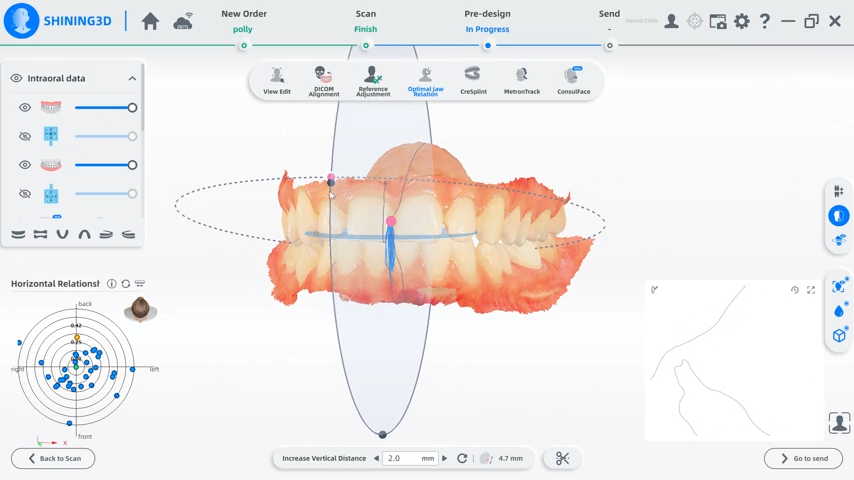
Accurate implant restoration requires a clear understanding of the relationship between the upper and lower jaws. A digital jaw relation record helps capture this spatial relationship and provides an important reference for prosthetic design.
When a jaw relation record is combined with dynamic movement data, clinicians can evaluate both the position and function of the jaw. This integrated approach provides more comprehensive information compared with relying only on traditional static records.
For complex implant cases, this combination can help dental professionals create restorations that better match the patient’s natural oral mechanics.
How Jaw Motion Analysis Supports Implant Treatment Planning?
- Improving Occlusal Design for Implant Restorations
Occlusion is one of the most important considerations in implant dentistry. Unlike natural teeth, implants lack periodontal ligaments, meaning they respond differently to loading forces.
An implant restoration that does not properly fit the patient’s functional movement pattern may experience excessive stress or require repeated adjustments.
By analyzing jaw motion, dentists can evaluate mandibular pathways and functional relationships during treatment planning. This information can help guide restoration design and support more balanced force distribution.
- Enhancing Full-Arch and Complex Implant Cases
Simple single-tooth implants may require less functional analysis, but complex cases often involve greater challenges. Full-arch restorations, multiple implants, and patients with existing occlusal problems require careful evaluation of jaw function.
In these situations, a detailed jaw relation record provides valuable information about jaw positioning, while movement analysis reveals how the patient functions during real activities.
Together, these digital records allow clinicians to develop treatment plans that consider both structural requirements and functional performance.
Digital Workflow With SHINING 3D DENTAL e-Motion
SHINING 3D DENTAL develops digital dentistry solutions that help professionals improve diagnosis, communication, and treatment efficiency. The e-Motion Workstation is an integrated digital platform designed to capture jaw relationships and analyze movement patterns.
The system supports digital jaw relation record acquisition and real-time jaw motion tracking, allowing clinicians to combine static and dynamic patient information within one workflow.
By integrating intraoral scanning, facial data acquisition, and motion analysis, the e-Motion Workstation helps create a comprehensive digital patient model. This approach supports implant planning by providing additional functional information for restoration design and clinical decision-making.
The platform is particularly useful for cases where accurate jaw function assessment is important, including implant restorations, full-mouth rehabilitation, and interdisciplinary dental treatments.
Benefits of Using Jaw Motion Analysis in Implant Dentistry
- More Predictable Treatment Planning
Every patient has unique jaw movement patterns, occlusal characteristics, and functional requirements. Using only general measurements may not fully represent individual differences.
Digital analysis provides additional clinical references that allow dentists to consider patient-specific movement behavior during implant planning. By incorporating a precise jaw relation record and functional movement data, dental professionals can make more informed decisions and improve treatment predictability.
- Reducing Communication Challenges Between Dentists and Laboratories
Implant treatment often requires close cooperation between clinicians and dental laboratories. Accurate data sharing is essential for designing restorations that meet both aesthetic and functional expectations.
A digital jaw relation record allows technicians to understand the patient’s jaw position more accurately, while jaw motion information provides insight into functional behavior. This complete digital dataset improves communication and helps laboratories create restorations that align with the dentist’s treatment objectives.
When Should Dentists Use Jaw Motion Analysis for Implant Cases?
Jaw motion analysis is not required for every implant procedure, but it can provide significant advantages in more complex situations, including:
- Full-arch implant rehabilitation
- Multiple implant-supported restorations
- Cases with complicated occlusion
- Patients requiring extensive prosthetic treatment
- Implant cases involving interdisciplinary planning
- Patients with concerns related to jaw function
For these applications, understanding both static jaw relationships and dynamic movement patterns can support better clinical decisions.
The Future of Implant Dentistry: Integrating Function Into Digital Planning
Successful implant treatment depends on achieving a balance between aesthetics, stability, and function. As digital dentistry continues to advance, implant workflows are expanding beyond traditional measurements toward more comprehensive patient analysis.
A digital jaw relation record provides essential information about jaw positioning, while jaw motion analysis reveals how the oral system performs during movement. Together, these technologies allow dentists to evaluate implant cases from a more complete perspective.
With solutions such as SHINING 3D DENTAL e-Motion, dental professionals can incorporate advanced functional data into modern implant workflows. By considering both static relationships and dynamic jaw behavior, clinicians can improve treatment planning and work toward more predictable implant restoration outcomes.

