An SCR catalyst is useful only while exhaust conditions place its active chemistry in a workable range. Diesel duty cycles do not hold temperature constant: idle, acceleration, and sustained load can expose the catalyst to very different inlet conditions.
A V₂O₅ catalyst label therefore does not settle the selection question. The temperature distribution of the intended engine must be compared with the operating window of the particular SCR formulation.
That comparison also prevents two product categories from being confused. A vanadium-based SCR washcoat for NOx reduction and a separate V₂O₅ oxidation-catalyst family may share an element without sharing an application.
One element can serve different reactions; formulation and operating medium define performance. The selection decision starts with the engine’s exhaust profile and the chemistry actually offered for that duty.
Use the Duty Cycle as the First Filter
A single peak exhaust temperature can conceal long periods at lower temperature, when a formulation may provide less useful activity. Equally, an average can hide short high-temperature excursions relevant to durability. A time distribution across representative operating points offers a stronger basis for selection. The inlet location, flow rate, and expected aging state should accompany that record.
The required NOx reduction depends on more than exhaust temperature. SCR reactions also involve ammonia supply, the NO/NO₂ ratio, and contact with the coated honeycomb.
Those variables do not make the temperature window optional; they explain why a published range is a screening tool rather than a guarantee for the installed system. Bench and engine tests still have to show conversion under the chosen conditions.
Where the engine spends most of its time matters as much as the extremes. A catalyst that is highly active during a brief hot interval may contribute less over a duty cycle dominated by cooler running. Conversely, an apparently favorable low-temperature chemistry must withstand the upper exposures it will encounter. The operating window should be read as part of a range-matching exercise.
A useful temperature profile records how long the catalyst inlet stays in each band, not merely its recorded peak. Two engines with the same peak can expose an SCR unit to different amounts of useful operating time. Flow and NOx concentration during those periods also matter, because a hot interval with little pollutant load contributes differently from a loaded interval at the same temperature.
Compare Published SCR Chemistry Windows
Within Hualian Catalyst diesel SCR range, the listed temperature windows are approximately 230–470°C for vanadium-based metal oxides, 190–550°C for Cu-zeolite, 450–620°C for Fe-zeolite, and 130–250°C for Mn-containing oxides.
These figures place several chemistries on different parts of a possible exhaust profile. They are not interchangeable ratings, and the ranges should not be treated as complete engine-level conversion curves.
An engine operating mainly around the lower edge of the vanadium interval presents a different selection problem from one that runs well inside it. The fraction of time in each region can be compared with required NOx control and with high-temperature durability needs. Such a comparison may favor a different washcoat, or it may show that system temperature management is the central constraint.
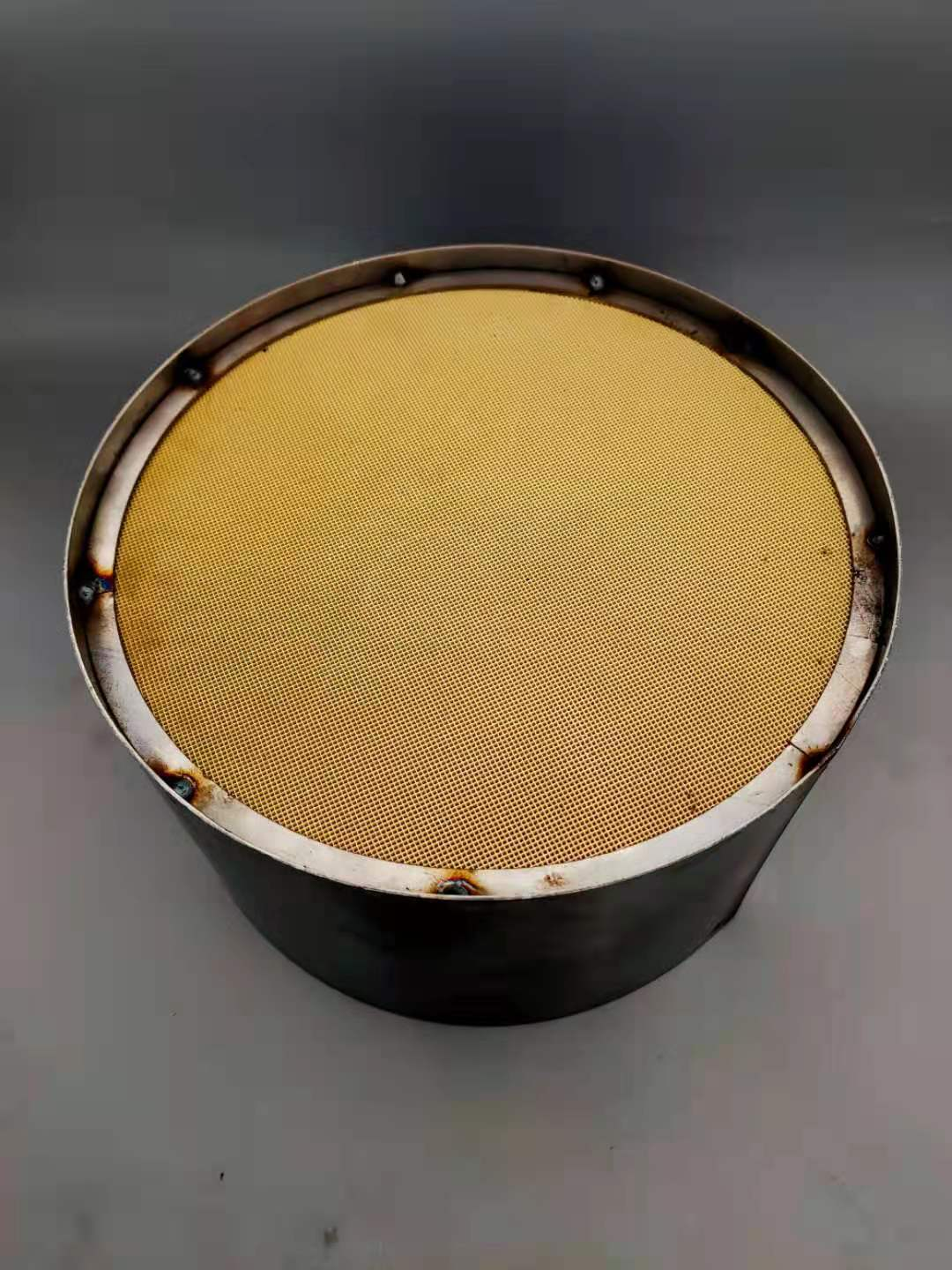
The SCR catalyst also has a physical form. Honeycomb geometry and pressure loss affect how the exhaust reaches active sites, while thermal expansion and vibration affect durability.
A promising chemical window can still be unsuitable if the assembled substrate exceeds backpressure or packaging limits. These structural checks belong alongside the temperature comparison, not after the chemistry has already been assumed correct.
The listed windows overlap in places, but overlap does not make the chemistries equivalent. A temperature inside two nominal ranges still leaves questions about NOx conversion, ammonia dosing, pressure loss, and durability.
The intervals narrow the shortlist for testing; they do not rank all candidates for a particular engine. Data from the proposed formulation under matched conditions remains the basis for a final comparison.
Keep the Separate V₂O₅ Product Family Distinct
Hualian also describes a V₂O₅ product family characterized by high-temperature oxidation activity and thermal stability. That description does not turn every product in the family into a diesel SCR washcoat. The intended reaction, supporting material, form, and test basis need to be identified before properties from one page are used to argue for another application.
This distinction matters when a V₂O₅ catalyst search leads to several kinds of product literature. A high-temperature oxidation claim does not itself predict NOx reduction in a urea-SCR system. Conversely, the 230–470°C range listed for Hualian’s vanadium-based diesel SCR formulations should not be applied to its separate industrial V₂O₅ catalyst family. The chemical name points to a material family; the product specification identifies the actual duty.
The final selection compares the measured exhaust temperature distribution with the stated window for the exact SCR formulation, then tests NOx conversion under relevant flow and dosing conditions.
If the engine spends too little time in that window, a familiar catalyst name cannot compensate. The selected vanadium chemistry belongs in the diesel SCR design only when its specific chemistry and substrate fit the engine’s real operating envelope.

